

The Department of Homeland Security will contribute USD625mn to the eleven US cities hosting next year’s FIFA World Cup
On October 28, the Department of Homeland Security announced that it would provide USD625mn for the eleven US cities hosting matches in next year’s FIFA World Cup, helping them meet security-related expenses. The tournament is already attracting political controversy as it intersects with US immigration policy, and in partisan terms, with President Donald Trump’s indication on October 14 that he might withdraw games from Democrat-controlled cities that he sees as experiencing civil unrest.
What’s next
The US president will want a successful World Cup as part of next summer’s celebrations of the country’s 250th birthday, but a range of protesters will also seek to exploit the stage it offers. The tournament’s security needs may provide a reason to send troops to the Democrat-controlled cities adjacent to the mostly suburban World Cup venues, where they may also be involved in the Trump administration’s immigration crackdown.
Subsidiary Impacts
- For business, a FIFA-sponsored study this year estimates that the World Cup will produce up to USD40bn for US GDP.
- High, dynamic ticket pricing will likely become an affordability issue, discouraging attendance.
- A city such as Boston could lose an estimated USD1bn in economic benefits if its World Cup games are relocated.
- FIFA’s statutes governing its member national football associations prohibit government interference in football-related matters.
Analysis
The 2026 edition of the quadrennial FIFA World Cup will begin next June. It will last for a record 40 days, coinciding with celebrations in the United States to mark the 250th anniversary of the signing of the Declaration of Independence.
As well as being the longest World Cup, it will be the largest, with 48 teams participating in the finals compared with 32 in the last tournament in Qatar in 2022. It will also be the first to be co-hosted by three nations — the United States, Canada and Mexico, although most of the games will be in the United States.
Trump, a sports enthusiast, has shown keen interest in the event. As the world’s most-watched sporting tournament, taking place on US soil during a celebratory summer, it will provide him with an unmatched global spotlight to showcase his presidency.
Football, business and politics
Although seemingly a global public event, a World Cup tournament is in fact a private business enterprise. World Cups are organised through commercial contracts between FIFA (the governing body of world football), the national football associations of the host countries and the organising committees of the municipalities where the games are played.
The World Cup is a private business enterprise
These agreements require all parties to uphold human rights in line with the UN Guiding Principles on Business and Human Rights. However, few expect FIFA to pay more than lip service to those requirements, or the Trump administration to reverse its own LGBTI+, transgender and gender equality policies. At the Qatar tournament in 2022, authorities removed rainbow flags and banners proclaiming gender equality from fans and stadiums.
The growing money and audience for the World Cup has made it an irresistible platform for civil rights and environmental activists. The 2026 edition will generate an estimated USD4.5bn in sponsorship, and is forecast to have 6.5 million spectators at games and more than 1 billion people watching the final online or on television.
Immigration
The president’s immigration crackdown and travel bans have raised significant concerns regarding the participation of fans and journalists from various countries in the upcoming tournament.
The White House has said that players and officials from all qualifying teams — including Iran, the only country to have qualified that is under US travel restrictions — will be allowed entry. However, there is no similar commitment for fans and journalists.
Key issues include:
Visa processing
The administration has not indicated plans for a streamlined visa process, as has been used in the two previous World Cups. Additionally, a USD250 integrity surcharge imposed on visa applications, along with substantial bonds ranging from USD5,000 to USD15,000 for applicants from countries with high visa overstay rates, will discourage travelling. These bonds affect six of the ten African nations expected to qualify.
Security risks
Visa applicants face extended processing times due to security checks, and even visa holders may be turned back or detained based on perceived political views or national origin. This risk is heightened as fans will have to travel between the three host nations. The visible presence of Immigration and Customs Enforcement agents during this summer’s Club World Cup, an administrative dress rehearsal for the World Cup, has further raised concerns about the potential for immigration enforcement actions during the tournament.
Political capriciousness
There are concerns that the president’s immigration policies could lead to unexpected additional restrictions; local media in Brazil have speculated on potential bans on Brazilian fans as a sanction for the prosecution of former President Jair Bolsonaro (see BRAZIL/US: New sanctions will harden diplomatic stasis – September 23, 2025).
Increased security
The president may seize the opportunity to deploy military and law enforcement personnel to Democrat-run host cities as part of a process of heightening security, raising fears about the stifling of dissent and expanding surveillance (see UNITED STATES: Use of National Guard troops may expand – August 22, 2025).
Game relocation
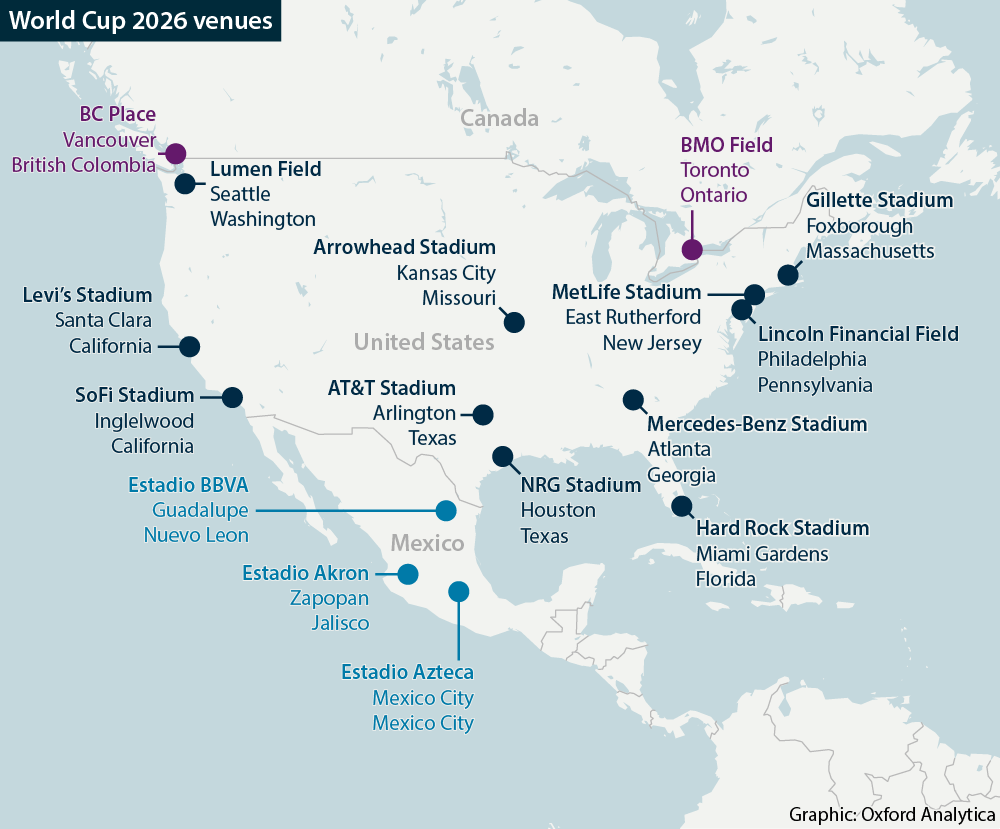
Trump has twice suggested he might move games from cities he deems unsafe, mentioning Boston — whose Democratic mayor looks set to win re-election next week — even though the games in the Boston area will be played 30 miles outside the city, in Foxborough.
FIFA will be reluctant to accept game relocations at this stage
The decision ultimately lies with FIFA. With only eight months until the tournament, FIFA President Gianni Infantino, who has cultivated a close relationship with the president, is likely to resist late logistical changes.
Israel
Trump’s invitation to Infantino to attend the signing of the Gaza ceasefire agreement underscores the geopolitical complexities surrounding the tournament. Israel is now highly unlikely to qualify for the finals, but its involvement in the qualification rounds has sparked protests and calls for its expulsion from the tournament.
Critics point out a perceived double standard, as Russia was rapidly suspended from participating in FIFA and UEFA competitions due to its invasion of Ukraine. Despite two years of war in Gaza, Israel has faced no footballing sanctions.
Environmental concerns
The 2026 World Cup will be among the most polluting sporting events ever to be staged. The vast distances teams and fans will have to travel between venues in Canada, Mexico and the United States, and the fact that most travel will be by air and road, mean that the tournament’s carbon footprint will be massive.
The US team, for example, will travel 2,000 miles to play its first three games. Many of the games in the United States are being played in suburban towns poorly served by public transport; the AT&T Stadium in Arlington, Texas, which will host more games than any other venue, has no public transport links.
Even at this relatively late stage, there are calls for FIFA and the host countries to implement green initiatives to mitigate the tournament’s environmental impact. These are likely to result in little action, however, at least in the United States.