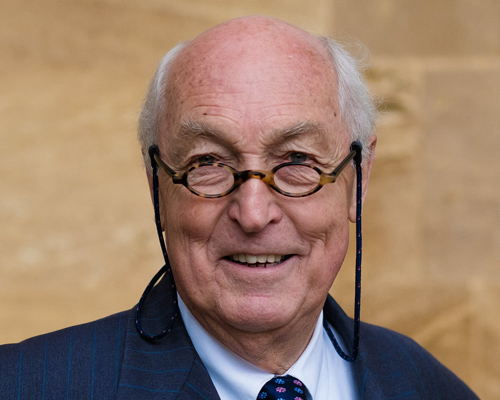
November 10, 1936 – December 24, 2025
It is with great sadness that we announce the passing of David R. Young (‘DRY’), the founder of Oxford Analytica. We extend our heartfelt condolences to his wife, Suzy, his entire family, and the many colleagues and friends who will feel his loss deeply.
David was the man who started it all. His simple but transformative idea was that the vast reservoir of talent at Oxford could, and should, be harnessed to provide decision-makers in business and government with objective analysis of world events. His own experience and deep personal faith made him believe that those in positions of power would more often than not make better choices if they could regularly draw on the insights of world-class scholars.
From this conviction came Oxford Analytica – founded in 1975 as a consultancy conducting political economy studies and then, in 1984, with the launch of the Oxford Analytica Daily Brief. Modelled on the President’s Daily Brief, which David had watched being produced by Henry Kissinger when he was on his staff during the first Nixon administration, it became the world’s first private-sector, open-source intelligence network.
The seeds of this vision were planted in David’s unusual journey across law, politics and academia. Born in the Hudson Valley, NY, he first came to Oxford in 1961 to read law at The Queen’s College. After qualifying in both the USA and UK he worked as a lawyer in New York with Millbank, Tweed, Hadley & McCloy. In 1968 he was seconded to the Rockefeller Family where he became Treasurer of the Rockefeller for President Campaign Committee. It was during this secondment that he met Henry Kissinger who, at that time, was an advisor to Nelson Rockefeller. After Kissinger joined the Nixon White House, it was not long before he asked David to be his personal aide and brought him onto the National Security Council. For the next four years David worked at the heart of American foreign policy, with a front row seat to one of the most intriguing periods of American history.
One of David’s most notable experiences during these years was to found the White House Special Investigations Unit (subsequently nicknamed ‘The Plumbers’ thanks to a comment from his mother on his new job ‘fixing leaks’). David kept his integrity intact throughout a trying period but, by 1974, he and Suzy were ready to return to Oxford, determined to reflect on what he had witnessed in Washington. He set to work on a D.Phil. regarding the decision-making in the Nixon White House while, in parallel, lecturing at Queen’s. It was at this point that his conviction took root that Oxford’s intellectual riches could be channelled to serve the wider world.
David led Oxford Analytica for over four decades, always ensuring that its founding principles endured. As Dr. Nicholas Redman, Editor-in-Chief of The Daily Brief, recalls: “Over time, the company has faced challenges on the integrity of its analysis. While others might have compromised, David stayed true to his principles. That commitment to honesty and veracity was his hallmark.”
His influence extended far beyond the business itself. Dr. Giles Alston, head of the North America desk, who worked with David since the 1980s, notes: “Everyone assumes the challenge was to persuade CEOs to sign on. But companies already knew they needed to understand the world better. The real challenge was convincing academics to write for a practical audience, in a different format and without their name attached. David had the talent and charisma to win them over and created the mindset that academics should have a more actionable impact. His conviction that what we were doing mattered brought an endless stream of talented people through the door, and he gave many their start in careers that would take them far in academia, intelligence, media and government.”
Beyond these professional achievements, it was the personal warmth and energy of David that stood out to so many. He ran a family business that treated everyone working at OA as such. He was personally generous and wise in counsel when asked. He always wanted the best for those around him and, of course, never stopped making introductions that he thought could shape the world for the better.
His legacy is not just the organisation he founded but the people he felt honoured to help and the enduring model he created. He built bridges between people. He built bridges between scholarship and decision-making.
All of us here at Oxford Analytica will miss David greatly – and we are proud to carry his vision forward.
His funeral will be held at St. Peter’s Church, Marsh Baldon, Oxfordshire at 2pm on Friday, 9th January. There will be a video link for those in the USA or abroad given no further memorial service will be held. Further details are available from Edward Carter Funeral Directors, Abingdon.